
SEER, SEER2, BTU, Ton, EER: What the Numbers on Your AC Label Actually Mean
You’re standing in your living room on a 95-degree summer day. The AC has been running for hours, the house still feels warm, and you already know the electric bill is going to hurt. So you start looking into a replacement system, hoping for a simple answer.
A few minutes later, you’re staring at a wall of HVAC terms that sound more like a math exam than something meant for homeowners. SEER2. BTU. Tons. EER. Every air conditioner label seems packed with numbers, ratings, and technical jargon that nobody actually explains in a way that makes sense.
At first glance, it feels confusing and overly complicated. But those numbers are not random. They tell you exactly how efficiently an AC system runs, how much cooling power it produces, how expensive it will be to operate, and whether it is even the right size for your home.
The problem is that most homeowners never get a clear explanation. They end up relying entirely on sales pitches, guessing based on price, or choosing the biggest unit assuming bigger automatically means better cooling. That often leads to higher energy bills, uneven temperatures, humidity problems, and systems that wear out faster than they should.
Once you understand what these ratings actually mean, the entire process becomes much easier. You can compare systems confidently, understand why one unit costs more than another, and avoid paying for equipment that does not fit your home or budget.
This guide breaks down SEER2, BTU, tonnage, and EER in plain English so you can understand what the numbers on your AC label are really telling you and how they directly affect your comfort, energy costs, and long-term savings.
Key Takeaways
- SEER2 ratings directly affect monthly cooling costs, long-term energy savings, and overall air conditioner operating efficiency.
- Proper BTU and tonnage sizing prevents constant runtime, uneven cooling, humidity problems, and premature system wear.
- Oversized air conditioners short-cycle frequently, wasting electricity and reducing overall system lifespan significantly over time.
- EER ratings measure cooling efficiency during extreme outdoor temperatures and matter greatly in hotter climates.
- Understanding AC label ratings helps homeowners avoid expensive installation mistakes and unnecessary long-term energy costs.
What SEER and SEER2 Actually Mean (and Why They Matter)
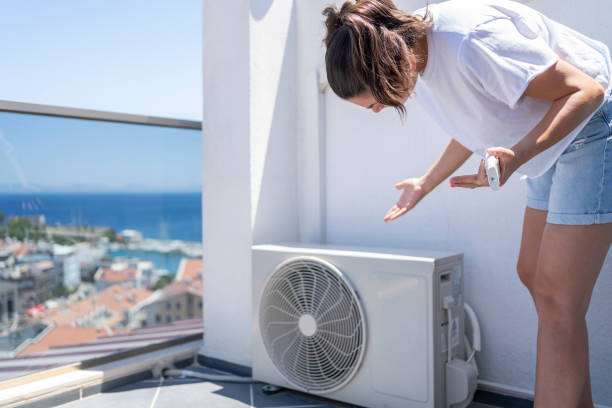
SEER stands for “Seasonal Energy Efficiency Ratio.” It’s a rating that tells you how efficiently an air conditioner operates over an entire cooling season, measured across a range of temperatures and humidity levels.
In simple terms: SEER2 is the cooling equivalent of miles per gallon. A higher number means the unit produces more cooling for every dollar you spend on electricity.
Before 2023, all AC units were rated using the old SEER standard. In January 2023, the U.S. Department of Energy rolled out SEER2, a more realistic testing method that reflects how air conditioners actually perform in real homes.
The new standard uses updated testing procedures that account for static pressure and higher outdoor temperatures, making SEER2 ratings inherently lower than old SEER ratings. This doesn’t mean modern units are less efficient. It means the testing is more honest.
Here’s what the numbers look like today. SEER ratings for air conditioning systems manufactured now range from 13 SEER2 to 24 SEER2. The difference between a 13 SEER2 unit and a 16 SEER2 unit might only add $1,000 to $2,000 to your upfront cost. But over 15 years, that difference could save you thousands.
Let’s put this in real money. Suppose you have a 3-ton AC unit that runs about 2,100 hours during a typical cooling season. Upgrading from a 10 SEER unit to a 16 SEER unit saves approximately $661 per year on energy costs, assuming electricity costs $0.14 per kilowatt-hour. Over 20 years, that single decision is worth $13,240 in savings. Over the typical 15-year lifespan of an air conditioner, you’re looking at nearly $10,000 in lower electric bills.
The regional minimums also matter. The Department of Energy sets different minimum SEER2 requirements depending on where you live. In North Carolina, the minimums are lower than in the Southeast. A 3-ton unit rated at 13.4 SEER2 might be perfectly compliant in one zip code and non-compliant in another. Before purchasing, check your local requirements.
BTU vs. Tonnage: Understanding Cooling Capacity
BTU stands for “British Thermal Unit.” It’s the amount of heat energy required to raise the temperature of one pound of water by one degree Fahrenheit. BTU measures how much heat your air conditioner can remove from your home in one hour.
This is where it gets confusing for homeowners. Contractors talk in “tons,” not BTUs. A 3-ton air conditioner doesn’t weigh three tons. It’s named after the cooling capacity of one ton of melting ice, which is exactly 12,000 BTU per hour. So the math is simple:
1 ton = 12,000 BTU per hour
A 2-ton AC = 24,000 BTU per hour A 3-ton AC = 36,000 BTU per hour A 4-ton AC = 48,000 BTU per hour A 5-ton AC = 60,000 BTU per hour
The tonnage tells you the cooling capacity. A larger home needs a higher tonnage unit. A smaller or well-insulated home needs a lower tonnage.
The standard rule of thumb is that you need 20 to 25 BTU per square foot of living space. If your home is 2,000 square feet, you’d multiply 2,000 by 20 to get 40,000 BTU (a 3.3-ton unit) on the low end, or 2,000 by 25 to get 50,000 BTU (a 4.2-ton unit) on the high end.
But this is just the starting point. Other factors adjust the calculation. A home with poor insulation, single-pane windows, or a lot of sun exposure needs more capacity. A brand-new home with high-quality insulation, modern windows, and good air sealing can often get away with less. This is why you want a contractor to perform a manual load calculation, not just guess based on your home’s square footage.
The most important thing to understand is this: bigger is not better. Many homeowners make the mistake of installing a unit that’s too large for their space. An oversized unit will reach the temperature set on your thermostat quickly, then shut off.
When it shuts off before it’s had time to run long enough, the unit never fully dehumidifies the air. Your home feels cool but clammy. The compressor also cycles on and off more frequently, which shortens its life and increases operating costs. Choose a unit that’s correctly sized for your home’s actual cooling load.
What EER Is and How It Differs from SEER2
You’ll occasionally see “EER” on AC spec sheets, and it’s worth understanding how it differs from SEER2.
EER stands for “Energy Efficiency Ratio.” Unlike SEER2, which averages efficiency across the entire cooling season at different temperatures, EER measures efficiency at one specific operating condition. The standard test temperature for EER is 95 degrees Fahrenheit outside and 80 degrees inside with 50% relative humidity.
In practice, this means EER tells you how efficiently the unit runs on the hottest, most demanding days of summer. SEER2 tells you how efficiently it runs across the whole season, including mild days in May and September when it’s easier to cool a home.
For homeowners, SEER2 is the more useful number because it reflects your actual energy costs year-round. EER becomes relevant when you’re comparing specific efficiency at peak conditions. Some contractors use EER when comparing units to be installed in extremely hot climates where the AC runs constantly at or near peak load. For most homeowners in North Carolina, focus on SEER2. That’s the rating that determines your electric bill.
How These Ratings Affect Your Energy Bills
This is the part that matters most. How much money will you actually save?
The relationship is proportional. An AC system with a SEER2 rating of 10 uses twice as much energy as one with a SEER2 rating of 20 during the same cooling season. If your new 20 SEER2 unit costs $100 per month to run, an older 10 SEER2 unit would cost roughly $200 per month to run the same space.
Let’s look at a real example. You have an 8 SEER air conditioner from 1995. You’re replacing it with a modern 16 SEER2 unit. Both are 3-ton units cooling the same 2,000-square-foot home. Assuming your electricity costs $0.14 per kilowatt-hour and your AC runs about 2,100 hours during the cooling season:
The old 8 SEER unit costs roughly $1,680 per year to operate. The new 16 SEER2 unit costs roughly $840 per year to operate. Your annual savings: $840.
Over 15 years, that’s $12,600 in energy savings from a single decision.
Even if you jump from a 10 SEER unit to a 13 SEER2 unit (a modest upgrade), you’re still saving around $200 per year, or $3,000 over 15 years.
The numbers are even more dramatic if you currently have a very old system. If your current AC is from the 1980s or early 1990s, it probably operates at 6 to 8 SEER. Upgrading to a modern 16 to 18 SEER2 unit could cut your cooling costs in half.
This is why professional AC installation and maintenance from a qualified contractor is so important. A properly installed, well-maintained system operates at peak efficiency. A poorly installed or neglected system will waste energy and money.
Choosing the Right AC System Size for Your Home
Sizing your AC system correctly is non-negotiable. You need a contractor who will actually measure your home and calculate the cooling load accurately, not someone who glances at your square footage and quotes a 4-ton unit for everything.

The process involves looking at several factors:
Your home’s square footage
- The number and size of windows
- The direction your home faces and sun exposure
- Your insulation quality and age
- Your local climate and average summer temperatures
- The number of people typically in your home
- Kitchen appliances and heat sources
A contractor performing a proper load calculation will account for all of these. Many use HVAC industry software that runs complex calculations based on your specific situation.
Once you know your correct tonnage, you then choose the highest SEER2 rating within your budget. In Fayetteville and surrounding areas, federal minimums require at least a 13.4 SEER2 for most new installations. Premium units go up to 18 or even 20 SEER2. The premium unit costs more upfront, but as we’ve shown, the energy savings add up quickly.
When you’re ready to move forward, don’t just compare prices. Compare efficiency ratings too. A cheaper 13 SEER2 unit might seem attractive, but a 16 SEER2 unit could save you $150-$200 per month in cooling costs and pay for itself in 4-5 years.
SEER2 vs. the Old SEER Standard: What Actually Changed
In January 2023, the industry switched to SEER2. This wasn’t just a rename. The testing procedure changed in ways that make SEER2 ratings inherently lower than old SEER ratings.
The old SEER testing used lower external static pressure and cooler test temperatures. Real-world AC systems face higher static pressure from ducts and registers, especially in homes with older ductwork or poor installation. The new SEER2 test uses higher static pressure that more accurately reflects field conditions.
Practically speaking, an old 16 SEER unit is roughly equivalent to a new 13 SEER2 unit in real-world performance. So if you see online discussions comparing a “16 SEER unit” from 2015 to a “13 SEER2 unit” from 2025, they’re roughly comparable.
This matters when comparing equipment. Always compare SEER2 to SEER2 and old SEER to old SEER. Don’t mix them. And when talking to contractors or researching equipment, ask specifically whether you’re looking at SEER2 or old SEER ratings to avoid confusion.
When considering replacement equipment, focus on SEER2. That’s the rating that applies today, it reflects current testing standards, and it’s what federal regulations now require..
How to Make Smarter Decisions About Your AC System
You now understand what these numbers mean. Here’s how to use that knowledge to make a smart decision.
Step 1: Get a proper load calculation. Don’t let a contractor quote you an AC system size without calculating your home’s actual cooling requirements. Request a home HVAC services assessment that includes a detailed load calculation. A reputable company will provide this at no charge.
Step 2: Understand the SEER2 ratings available in your region. Call your local utility company or ask your HVAC contractor what minimum SEER2 your area requires. Then look at what efficiency tiers are available above that minimum. For example, if the minimum is 13.4 SEER2, look at 14, 15, 16, and 18 SEER2 options. Calculate the annual energy cost difference between each tier. The higher efficiency will almost always pay for itself.
Step 3: Ask your contractor which model they recommend and why. Make sure it meets your region’s current standards. Verify the model number in the AHRI Certified Directory to confirm it’s rated as claimed.
Step 4: Get everything in writing. Your quote should specify the exact model, the SEER2 rating, the tonnage, the expected installation timeline, and any warranty or maintenance agreements included.
Step 5: Invest in maintenance once it’s installed. An AC system will only perform at its rated efficiency if it’s properly maintained. Annual inspections, refrigerant level checks, and filter replacements keep the system running at peak performance and extend its lifespan.
When you’re ready to move forward, work with a contractor who understands these ratings and can explain them in clear terms. You should feel confident about your decision, not overwhelmed by jargon. If your contractor can’t explain what SEER2, tonnage, and EER mean in straightforward language, find someone who can.
At A/C Man Heating & Air Conditioning, we help homeowners in Fayetteville and surrounding areas navigate these exact decisions. Whether you need to request an HVAC estimate for a new system, understand your current unit’s efficiency, or explore energy-saving options, our team breaks down the numbers and explains your options clearly. We’ve helped hundreds of families reduce their cooling costs and improve their comfort by choosing the right system the first time.
FAQs
What SEER2 rating should I aim for?
In North Carolina, the minimum SEER2 for most new installations is 13.4. For the best balance of energy savings and upfront cost, aim for 15-16 SEER2. If you plan to stay in your home for 15+ years, a 16-18 SEER2 unit offers excellent long-term value through energy savings. Calculate the annual difference in cooling costs and divide by the price difference. If the higher efficiency pays for itself in 5-7 years, it’s worth the extra investment.
Can I upgrade just the outdoor unit and keep my indoor unit?
Not always. Modern SEER2 outdoor units are designed to pair with specific indoor units. If you only replace the outdoor unit and keep an old indoor unit, you won’t achieve the rated SEER2. In most cases, replacing both the outdoor condenser and indoor evaporator coil is necessary to meet current standards and achieve the efficiency rating you paid for. Your contractor will determine what replacement strategy makes sense for your specific situation.
How do I know if my current AC is properly sized?
If your AC runs constantly on hot days but never quite reaches your set temperature, it’s undersized. If it cools your home very quickly then shuts off for long periods, leaving humidity in the air even though it feels cool, it’s likely oversized. The best way to know is to have a contractor perform a load calculation on your home. They’ll provide a specific tonnage recommendation based on your home’s characteristics, not just guesswork.
Does a higher SEER2 rating really save money on electric bills?
Yes, absolutely. The math is straightforward: higher SEER2 means lower energy consumption, which means lower bills. A jump from 13 to 16 SEER2 typically saves $150-$250 per month in cooling costs over the summer months, depending on how much you run the system and your local electricity rates. Over the 15-year life of the equipment, those savings add up to thousands of dollars.
What’s the difference between SEER2 and EER, and which should I care about? SEER2 measures average efficiency across the entire cooling season at varying temperatures. EER measures efficiency at one specific hot condition (95 degrees outside). For most homeowners, SEER2 is more relevant because it reflects your actual energy costs year-round. EER becomes useful for sizing in extreme climates, but North Carolina homeowners should focus on SEER2.
