
What Size Central AC Do I Need? A Fayetteville Homeowner's Sizing Guide
You’ve received two estimates for a new central AC system. One contractor recommends a 3-ton unit, while another insists you need a 4-ton system to handle Fayetteville’s hot, humid summers. With both recommendations coming from experienced professionals, it’s easy to wonder which one is actually right.
The truth is that choosing the larger system isn’t always the better decision. An oversized air conditioner can cool your home too quickly, leave excess humidity behind, increase energy costs, and wear out faster. On the other hand, a system that’s too small may struggle to keep your home comfortable during the hottest days of the year.
The right AC size depends on much more than your home’s square footage. Factors like insulation, ceiling height, window placement, sun exposure, and your home’s overall layout all play a role.
In this guide, you’ll learn how central AC sizing works, why proper sizing matters for Fayetteville homes, and how to make sure you choose a system that delivers reliable comfort and energy efficiency for years to come.
Key Takeaways
- Most Fayetteville homes need roughly 1 ton of cooling per 400 to 600 square feet.
- A typical 2,000 square foot home usually lands around 3 tons, or 36,000 BTU.
- Square footage gives only a rough starting estimate, never the final sizing answer for your home.
- Oversizing causes short cycling, poor humidity control, higher energy bills, and early equipment failure.
- A Manual J load calculation is the only reliable way to size your system.
The Short Answer: How AC Size Is Measured
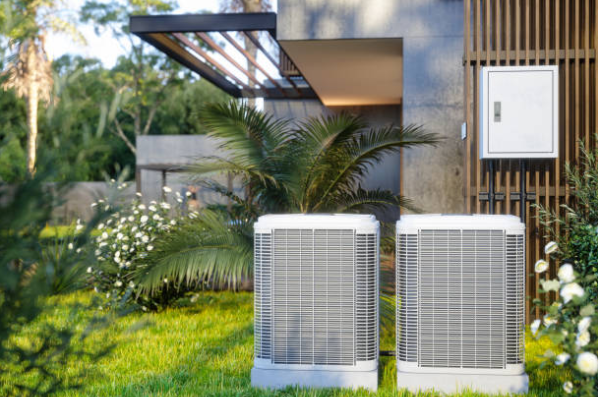
Air conditioner size is measured in tons, and one ton equals 12,000 BTUs of cooling capacity per hour. It has nothing to do with weight. A “3-ton” system can remove 36,000 BTUs of heat from your home every hour.
Residential central AC units come in standard sizes that step up in half-ton increments. You’ll almost always see these:
Model / BTU | Tonnage |
18,000 BTU | 1.5 tons |
24,000 BTU | 2 tons |
30,000 BTU | 2.5 tons |
36,000 BTU | 3 tons |
42,000 BTU | 3.5 tons |
48,000 BTU | 4 tons |
60,000 BTU | 5 tons |
Notice there’s no 2.75-ton or 3.25-ton unit. Manufacturers only build these fixed sizes, which is exactly why getting the calculation right matters. You’re choosing the closest correct fit, not dialing in a custom number.
The Square-Footage Rule of Thumb (and Why It’s Only a Starting Point)
The quick estimate most people find online uses square footage. It’s useful for a ballpark, and it’s the reason you’ll see rough charts like this one:
Home Size | Rough AC Size |
600-1,000 sq ft | 1.5-2 tons |
1,000-1,500 sq ft | 2-2.5 tons |
1,500-2,000 sq ft | 2.5-3 tons |
2,000-2,500 sq ft | 3-3.5 tons |
2,500-3,000 sq ft | 3.5-4 tons |
3,000-3,500 sq ft | 4-5 tons |
The math behind it is simple: about 20 BTU of cooling per square foot of living space. A 1,800 sq ft home works out to roughly 36,000 BTU, or 3 tons. That tracks with what most sizing guides report: a 2,000 sq ft house typically needs around a 3-ton unit.
The catch is that this method assumes your home is average in every way. It isn’t. Two homes on the same Fayetteville street with identical square footage can need different systems depending on how they’re built and where the sun hits them. Treat the square-footage number as a sanity check, not a spec.
Why “Bigger” Is the Most Expensive Mistake in Fayetteville
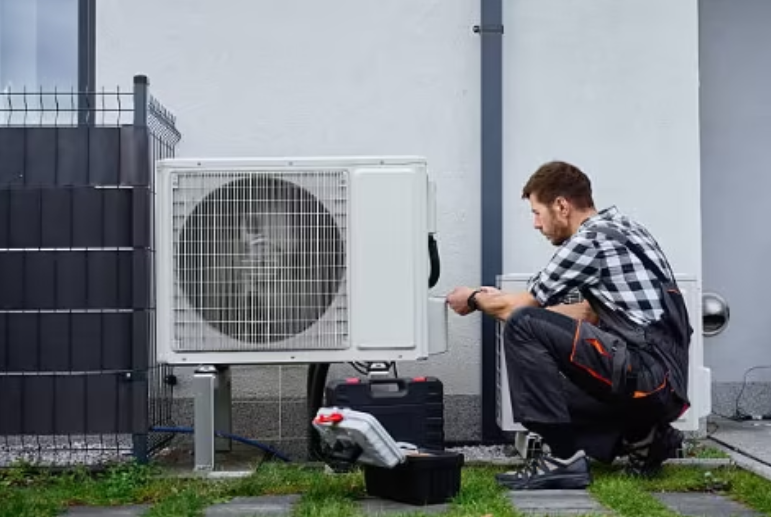
Oversizing an AC is the single most common sizing error, and it backfires in ways most homeowners never see coming. The instinct is understandable. If summers here push into the 90s, wouldn’t a bigger unit keep you more comfortable? Actually, no. It usually does the opposite.
Here’s what happens. An oversized system cools the air in your home to the thermostat setting very quickly, then shuts off. Then it turns back on a few minutes later, cools fast, and shuts off again. This rapid on-off pattern is called short cycling, and it creates three real problems: your home never dehumidifies properly, your energy bills climb, and the constant starting and stopping wears the equipment out early.
The humidity piece is the one that bites hardest in our area. An air conditioner removes moisture from your air only while it’s actively running. Short, fast cycles don’t give it enough runtime to pull humidity out. Fayetteville summers are muggy.
July averages a high near 90°F with heavy humidity, according to climate data for the area. An oversized unit can leave your house feeling cold and clammy at the same time, which is why some homeowners crank the thermostat lower and lower, chasing comfort they can’t reach.
This isn’t a rare edge case. According to ENERGY STAR’s quality installation guidance, a large share of heating and cooling equipment in U.S. homes never performs to its advertised capacity and efficiency, often because of poor sizing and installation.
A U.S. Department of Energy field study puts it even higher, noting some estimates that more than 65% of residential HVAC systems have been improperly installed and run below their potential. Sizing is at the center of that problem.
Undersizing has its own downsides. A unit too small runs constantly, struggles on the hottest days, and still runs up your bill. But in practice, the errors we see most often lean toward too big, not too small.
What Actually Determines Your AC Size: The Manual J Load Calculation
The right way to size a central air conditioner is a Manual J load calculation. It’s the industry-standard method developed by the Air Conditioning Contractors of America, and it measures how much heat your specific home gains on a hot day, which is the number that actually tells you how much cooling you need.
Square footage is only one input. A proper load calculation also weighs:
- Insulation levels in your walls, attic, and floors: poor insulation means more heat gain and a larger load
- Windows: how many, which direction they face, whether they’re single or double pane, and how much afternoon sun they take
- Ceiling height: a home with 10-foot ceilings has far more air volume to cool than the square footage suggests
- Air sealing and ductwork: leaky ducts and drafty framing can waste a third of your system’s capacity before it reaches your rooms
- Sun exposure and orientation: a west-facing Fayetteville home bakes in the late-afternoon heat differently than a shaded lot
- Occupancy and heat sources: people, appliances, and electronics all add to the cooling load
- Local design temperature: the calculation is built around the peak summer conditions our region actually hits, not a national average
Run those numbers and two homes with the same footprint can land a full ton apart. That’s the whole point: the Manual J tells you what your house needs, not what the house next door needs. When it’s time for professional central air conditioning services, whether that’s a new install or replacing a worn-out system, a load calculation should be the first step, not an afterthought.
Signs Your Current AC Is the Wrong Size
If you’re wondering whether your existing system was sized correctly, your home is already giving you clues. Watch for these:
- It turns on and off frequently, with cycles that last only a few minutes, a sign of an oversized unit
- The air feels cold but damp, a comfort-killer that signals poor humidity removal
- Some rooms never cool down while others feel like a freezer, a sign of uneven temperatures
- It runs nonstop on hot days and still can’t hit the setpoint, a classic undersizing sign
- Your energy bills are higher than neighbors with similar homes
- The system is wearing out early, with repeated repairs before its expected lifespan
One or two of these can have other causes, like a refrigerant or airflow issue. But a cluster of them usually traces back to a unit that was never the right size for the home.
Common AC Sizing Mistakes to Avoid
The fastest way to end up with the wrong system is to skip the calculation. These are the shortcuts that get homeowners in trouble.
Matching the old unit’s size. If your last system was oversized, and given the odds it may have been, replacing it with the same tonnage just carries the mistake forward. Renovations, new insulation, or replacement windows can also change your load since the original install.
Rounding up “to be safe.” Adding half a ton for peace of mind is the exact move that creates short cycling and humidity problems. Right-sized beats are oversized every time.
Relying only on an online calculator. A BTU calculator is a fine way to get a rough number and set expectations. It can’t inspect your attic insulation, measure your ducts, or account for that wall of west-facing windows. Use it to get oriented, then let a technician verify with a real load calculation.
Sizing on square footage alone. By now this one should be clear. It’s a starting point, never the final answer.
How to Get the Right-Sized AC for Your Fayetteville Home
The right size isn’t the biggest system you can afford or the one that matches your old unit. It’s the one your home’s actual cooling load calls for. Nail that, and you get a house that stays comfortable and dry through August, lower monthly energy bills, and equipment that lasts closer to its full lifespan instead of burning out early. Get it wrong, and you pay for it every month you own the home.
That’s why an online estimate can only take you so far. The homeowners who get this right are the ones who bring in a professional to measure the load before they buy.
At A/C Man Heating and Air, we’ve been sizing and installing systems across Fayetteville and the surrounding communities for nearly two decades. As a veteran-owned, locally licensed and insured team with 800+ verified 5-star reviews, we run proper Manual J load calculations instead of guessing from square footage, and we give you an honest recommendation with no pressure to buy more system than your home needs.
If you’re replacing an AC, building new, or just want to know whether your current unit is the right fit, schedule an in-home sizing assessment or call us directly at (910) 797-4287.
FAQ
What size central AC do I need for a 2,000 sq ft house in Fayetteville?
A 2,000 sq ft home typically needs around a 3-ton (36,000 BTU) system based on the general rule of about 20 BTU per square foot. That’s a starting estimate, not a final answer. Ceiling height, insulation, window exposure, and our humid summers can push the right size up or down, which is why a Manual J load calculation is the only way to be sure.
How many square feet does 1 ton of AC cool?
As a rule of thumb, 1 ton of cooling covers roughly 400 to 600 square feet, depending on how the home is built and insulated. So a 3-ton unit is often paired with homes in the 1,500 to 2,000 sq ft range. Local climate and construction details shift that range, so use it as a guide rather than a guarantee.
Is it better to oversize or undersize an air conditioner?
Neither. The goal is the correct size. If you have to lean one way, undersizing is usually less damaging than oversizing, because an oversized unit short cycles, controls humidity poorly, and wears out faster. In a humid climate like Fayetteville, poor humidity control from an oversized system is a frequent comfort complaint. A right-sized system beats both.
What is a Manual J load calculation and do I really need one?
Manual J is the industry-standard method for calculating exactly how much cooling your specific home needs. It accounts for insulation, windows, ceiling height, air sealing, ductwork, sun exposure, and local design temperatures. Yes, you need one. It’s the difference between a system that’s sized for your house and one that’s merely a guess.
How do I know if my current AC is the wrong size?
Common signs include frequent short cycling, air that feels cold but damp, rooms that cool unevenly, a system that runs nonstop on hot days without reaching the setpoint, and higher-than-expected energy bills. Any of these can have other causes, but together they often point to a sizing problem worth having checked.
