
Dual Fuel Heating Systems: Are They a Smart Fit for Fayetteville Winters?
It’s 6 a.m. on a February morning in Fayetteville. Snow covers the ground, the thermometer reads 20 degrees, and your heat pump has been running nonstop since midnight. You hear the backup heat strips click on, and you already know what the next power bill will look like.
That scene is exactly why so many homeowners here ask about dual fuel heating systems. Here’s the honest answer: dual fuel is a smart fit for a specific kind of Fayetteville home, not for every home. If you already have natural gas and a house that loses heat quickly, it can be the most comfortable and cost-effective setup available. If you don’t, a well-sized heat pump usually wins on its own.
Key Takeaways
- A dual-fuel heating system pairs an electric heat pump with a gas furnace, using the heat pump for most of the year and switching to gas when it gets cold enough that gas is the better choice.
- Fayetteville winters are mostly mild, but cold snaps are real. January 2025 averaged 5.1 degrees below normal at Fayetteville Regional Airport, and the winter of 2026 brought back-to-back storms with lows near 10 degrees.
- The switchover temperature matters more than any other setting. Set it too high and you burn gas you don’t need. Set it a few degrees above your home’s balance point and the system does what it was designed to do.
- Fayetteville PWC’s residential electric rate has a winter on-peak window from 6 a.m. to 9 a.m., the same hours your heating works hardest, which can tilt the math toward gas on the coldest mornings.
- Dual fuel makes the most sense for homes that already have a gas line, older or drafty homes, and households replacing both a furnace and an air conditioner at once.
- The federal heat pump tax credit ended for systems installed after December 31, 2025, and recent state rebate changes limit rebates tied to gas equipment, so confirm incentives before you count on them.
What Is a Dual Fuel Heating System?
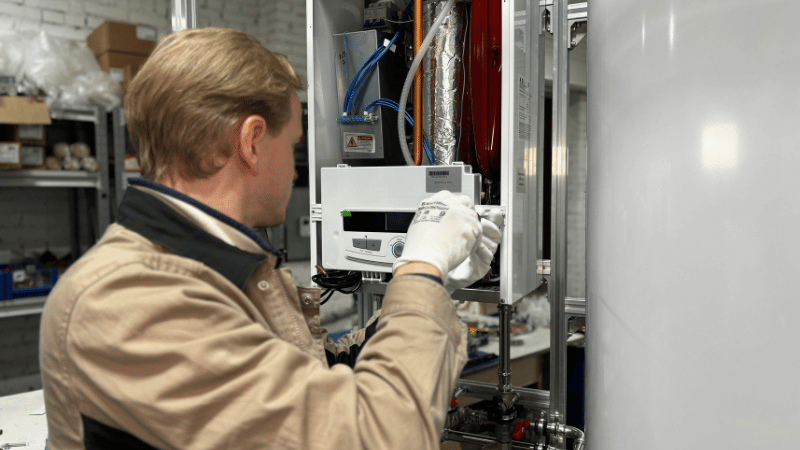
A dual fuel heating system, sometimes called a hybrid heat system, combines two heat sources under one set of controls. An electric heat pump handles cooling all summer and heating on mild winter days. A gas furnace takes over when outdoor temperatures drop low enough that the heat pump struggles or becomes more expensive to run.
A compatible thermostat or control board watches the outdoor temperature and decides which source runs. Both share the same ductwork and blower, with the heat pump’s indoor coil sitting on top of the furnace. The idea is simple: use electricity when it’s cheaper, use gas when it’s cheaper. The trick is knowing where that line falls in your house, on your rates, in our climate.
How Cold Do Fayetteville Winters Actually Get?
Most Fayetteville winters are mild, which is why heat pumps are so common across Cumberland County. But “mild on average” hides sharp cold snaps, and those days decide whether dual fuel pays off.
Look at January 2025. According to the National Weather Service office in Raleigh, Fayetteville averaged 38.9 degrees that month, 5.1 degrees below normal. The low hit 15 degrees on January 23, and the month’s average low was under 28 degrees.
The 2025 to 2026 winter was rougher. The City of Fayetteville and Cumberland County both declared states of emergency ahead of a winter storm on January 24, 2026, with forecasts for freezing rain, sleet, and snow. A week later, another storm dropped roughly 3 to 4 inches of snow on Fayetteville, with local reports reaching 5 inches in Bonnie Doone. Temperatures sat near 20 degrees that morning, with an overnight low forecast near 10.
During that stretch, Duke Energy asked customers to voluntarily cut power use on the morning of February 2 to ease strain on the grid. Fayetteville doesn’t stay cold for long, but those spikes are exactly when an all-electric system leans on expensive backup heat and a dual-fuel system quietly switches to gas.
How a Heat Pump Handles Cold Weather
A heat pump doesn’t create heat. It moves heat from outside air into your home. That’s why it’s so efficient. The U.S. Department of Energy notes that a properly installed air-source heat pump can deliver up to three times as much heat energy as the electrical energy it uses.
The catch is that outdoor air has less heat as temperatures fall. A standard heat pump’s heating capacity drops as it gets colder, while your home’s heat loss climbs. At some point, the heat pump can’t keep up.
When that happens, most all-electric systems turn on electric resistance heat strips inside the air handler. Those strips turn one unit of electricity into one unit of heat, far less efficient than the heat pump itself.
Defrost cycles add to it. In cold, damp weather, the heat pump briefly reverses to clear ice off the outdoor coil, and backup heat usually kicks on to keep cold air out of your vents.
Modern cold-climate heat pumps handle low temperatures much better than older models, and for many Fayetteville homes, a good heat pump alone is enough. We go deeper into how today’s equipment performs when it’s freezing outside in our post on whether heat pumps work in cold weather.
Dual fuel replaces those electric heat strips with a gas furnace. Instead of switching to the least efficient form of electric heat on the coldest days, the system switches to gas.
The Switchover Point: Where Dual Fuel Earns Its Keep
Every dual fuel system has a switchover temperature. Above it, the heat pump runs. Below it, the furnace takes over. Getting this number right is the difference between a system that saves money and one that just burns gas.
There are two ways to think about it.
The balance point. This is the outdoor temperature where your heat pump’s capacity exactly matches your home’s heat loss. Below it, the heat pump can’t keep the house warm on its own. A tight, well-insulated home has a lower balance point. A drafty older home has a higher one.
The economic switchover. This is the outdoor temperature where gas becomes cheaper per unit of heat than running the heat pump. It depends on your electric rate, your gas rate, and each piece of equipment’s efficiency.
Research on dual fuel controls backs up a simple rule. A 2026 field guide from the Northwest Energy Efficiency Alliance found that switchover temperature is the single biggest factor in how much gas a dual fuel system uses. Its modeling showed gas use dropping by more than half when switchover moved from 40 degrees down to 35 degrees, and dropping further at 30 degrees. Its recommendation was to set the switchover a few degrees above the home’s balance point, because setting it any higher wastes the heat pump you paid for.
If your system is set at a conservative 40 degrees, the furnace may be handling Fayetteville winter nights the heat pump could cover just fine. A good installer calculates your home’s balance point and sets the switchover to match.
Running the Numbers on Fayetteville Utility Rates
Whether dual fuel saves you money depends on what you pay for electricity and gas. Fayetteville has a local twist that most national articles miss.
Fayetteville PWC’s residential electric rate schedule, effective May 1, 2026, charges about 15 cents per kWh during on-peak hours and about 9.8 cents per kWh off-peak, plus a monthly basic facilities charge and a power supply adjustment. From November through March, the on-peak window runs from 6 a.m. to 9 a.m.
Those are exactly the hours your heating works hardest, when the house has cooled overnight and outdoor temperatures bottom out. An all-electric PWC home does its heaviest lifting at the highest price, often with heat strips running. A dual fuel system can run the furnace through that window, then hand off to the heat pump as the day warms up.
To see where your own break-even point sits, you need three numbers:
- Your all-in electric rate per kWh, including the time of day you’ll be heating
- Your gas rate per therm, from your Piedmont Natural Gas bill
- The efficiency of your heat pump at cold temperatures and the efficiency rating (AFUE) of your furnace
One therm of gas contains about 29.3 kWh of energy. If your heat pump is delivering twice as much heat as it uses in electricity on a cold morning, it needs about 14.7 kWh to produce a therm’s worth of heat. At PWC’s on-peak rate, that’s roughly $2.20 in electricity. At the off-peak rate, it’s about $1.43. Compare those figures to what a therm of gas costs you, adjusted for your furnace’s efficiency, and you’ll see which fuel is cheaper at that hour.
Rates move both ways. PWC has another increase scheduled for May 2027, while Piedmont Natural Gas cut residential rates 4.35 percent in June 2026. Run the comparison with your actual bills, not national averages.
When Dual Fuel Is a Smart Fit in Fayetteville
Dual fuel shines in these situations.
You already have natural gas. If a gas line already runs to your home and your furnace works, the furnace side of dual fuel is low-cost to keep. Running a new gas line just to add dual fuel changes the math considerably.
Your home is older or drafty. Older homes in Haymount, around downtown, and in many postwar neighborhoods lose heat faster than newer construction. Their balance point is higher, so a heat pump alone leans on backup heat more often. Gas covers those hours more comfortably.
You’re replacing both systems at once. If your air conditioner and furnace are both near the end of their life, replacing the AC with a heat pump and keeping (or upgrading) the furnace gives you dual fuel without paying for two separate projects later.
You prefer warmer supply air. A gas furnace blows noticeably warmer air than a heat pump, which many households find more comfortable on cold mornings.
You want less dependence on electric resistance heat. During cold snaps like the February 2026 storm, when Duke Energy asked customers to cut use, a dual fuel home isn’t pulling heavy power for heat strips. That’s easier on your bill and on the grid.
One honest caveat: a gas furnace still needs electricity to run its blower, igniter, and controls. Dual fuel is not a backup for a power outage. If the power goes out, both halves stop.
When a Heat Pump Alone Makes More Sense
For many Fayetteville homes, a standalone heat pump is the better call.
You don’t have gas service. Bringing a new gas line to the house, plus venting and permits for a furnace, can erase years of potential savings. A modern heat pump with modest backup heat is usually the smarter investment.
Your home is newer and well sealed. Tight, well-insulated homes have low balance points. The heat pump covers almost every hour of a Fayetteville winter, so the furnace would rarely run.
If you’re leaning this way, our team can walk you through sizing and efficiency options for heat pump installation and service in Fayetteville.
Permits, Licensing, and Rebates for Dual Fuel in Fayetteville
Dual fuel involves electrical, refrigerant, and gas work, so it carries more requirements than a simple swap.
Permits. Replacing or adding heating and cooling equipment in Fayetteville requires a mechanical permit and inspection through the city or Cumberland County, depending on where you live. Gas piping and furnace venting are part of what the inspector checks.
Licensing. North Carolina requires HVAC contractors to hold the right license class from the State Board of Examiners of Plumbing, Heating and Fire Sprinkler Contractors. Gas piping work also requires appropriate licensing. Anyone handling refrigerant needs EPA Section 608 certification. Ask for license numbers and verify them on the board’s website.
Carbon monoxide safety. Any home with a gas furnace needs working carbon monoxide alarms on every level and near bedrooms, and every furnace inspection should include a heat exchanger and venting check.
Federal tax credit. The Energy Efficient Home Improvement Credit, which offers up to $2,000 for qualifying heat pumps, applies only to equipment placed in service through December 31, 2025, according to the IRS. Systems installed in 2026 don’t qualify.
State rebates. Energy Saver North Carolina, run by the NC Department of Environmental Quality, offers income-qualified HOMES and HEAR rebates. Under federal guidance the program adopted on September 1, 2026, HEAR rebates no longer cover replacing gas or other fossil fuel appliances, and some heat pump projects may also require insulation and air sealing. Fayetteville PWC co-promotes the program with its customers. Rules shift often, so check current terms with NCDEQ before planning around a rebate.
Mistakes to Avoid With a Dual Fuel System
A well-chosen system still underdelivers if it’s set up poorly.
Leaving the factory switchover setting. A switchover set too high turns your heat pump into an air conditioner with a side job. Ask your installer what temperature they chose and why.
Skipping the load calculation. Without a Manual J calculation, the switchover setting is a guess.
Using a thermostat that can’t manage dual fuel. The thermostat or control board has to be set up for dual fuel, with an outdoor sensor or outdoor temperature data. A basic thermostat can run both heat sources at once or switch at the wrong time.
Ignoring the ductwork. Leaky crawl space or attic ducts waste heat from both systems.
Is Dual Fuel the Right Fit for Your Fayetteville Home?
So, are dual fuel heating systems a smart fit for Fayetteville winters? For homes with gas service, older construction, or a need to replace both a furnace and an air conditioner, the answer is often yes. Our winters are mild enough for a heat pump to carry most of the load and cold enough, on the mornings that matter, for gas to earn its place.
For newer, tighter homes without gas, a quality heat pump alone is usually the better value.
At A/C Man Heating and Air, we install and service heat pumps, gas furnaces, and dual fuel systems across Fayetteville, Hope Mills, Spring Lake, and Fort Bragg. Every recommendation starts with a Manual J load calculation, and we lay out repair-versus-replace pricing side by side so you can compare a heat pump, a dual fuel setup, and a furnace upgrade with real numbers. If you’re weighing your options before next winter’s first cold snap, our veteran-owned team will help you find the setup that fits your home and your budget.
FAQ
What is a dual fuel HVAC system?
A dual fuel system pairs an electric heat pump with a gas furnace. The heat pump handles cooling and most heating, and the furnace takes over when outdoor temperatures drop below a set switchover point. Both share the same ductwork and controls.
At what temperature should a dual fuel system switch to gas in Fayetteville?
There’s no single right number. Set the switchover a few degrees above your home’s balance point, which depends on its insulation, air leakage, and heat pump size. Your utility rates also matter, since PWC’s winter on-peak hours can make gas cheaper on cold mornings.
Is dual fuel cheaper than a heat pump alone in North Carolina?
It depends on your home and fuel prices. Dual fuel tends to save more in drafty homes with existing gas service, because it avoids expensive electric resistance backup heat. In tight homes without gas, a heat pump alone is usually cheaper to install and run.
Can I add a heat pump to my existing gas furnace?
Often, yes. If your furnace is in good condition and compatible, a contractor can replace your air conditioner with a heat pump and add dual fuel controls. Fayetteville requires a permit and inspection for this work.
